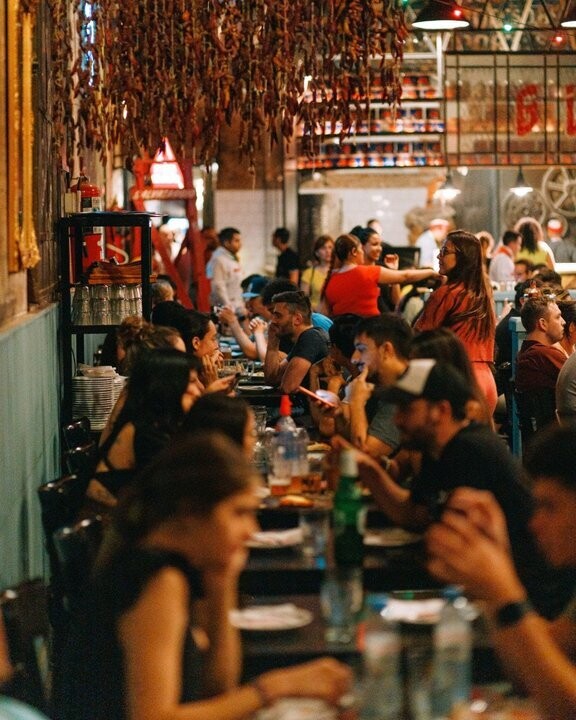
In Argentina, grilling is very common at home. The most requested by Argentines, both in the pan and on the stone, has always been the classic mozzarella pizza. According to a survey by the Argentine Association of Pizzerias and Empanada Houses, 33% of Argentines choose a mozzarella pizza. Among the other most eaten are the famous “Especial” with ham and peppers and the classic Napolitana. The onion pizza, also known as fugazzeta, is another classic that is always among the most requested. Since 1932, right on Corrientes Avenue, Güerrín has been the perfect excuse for many to gather with family, to celebrate a birthday without too many plans, or to fulfill an inherited ritual: to go “eat a good pizza” standing at the counter. Celebrating Pizza Day at Güerrín is not only about paying homage to an iconic recipe, but also about reconnecting with those simple moments that, over time, become unforgettable. On February 9, 2026, the iconic Güerrín pizzeria on Corrientes Avenue will not be just another day. It will host the World Pizza Day celebrations and will shine its name in a central place not only in gastronomic conversation but also in the emotional memory of thousands of people over decades. Together with Las Cuartetas or El Cuartito, Güerrín is part of the classic podium of pan pizzas, while Pizza Piola, Cosí mi piace or Albamonte are the most renowned for stone-fired pizza. Although the exact origin of pizza is not certain—some say the Greek civilization already cooked it—its greatest reign is in Italy. The European country popularized it and began to serve it over 2000 years ago in the region of Naples, as is recognized. UNESCO declared the “art of the Neapolitan pizzaiuoli” as Intangible Cultural Heritage of Humanity and established January 17 to celebrate its day, coinciding with the feast of Saint Anthony the Abbot, patron saint of pizzaioli and fire. It did not take long to expand to other parts of the world and to take many forms according to each region. From this classic, many variants derived and some gained unusual fame, such as the filled fugazzetta pizza. Argentina is the country with the most pizzerias per capita. The tradition of pizza in Argentina is almost as strong as in Italy; in fact, it is the place in the world with the most pizzerias per capita. The City of Buenos Aires has more than 3,000 active establishments, even surpassing Naples or New York itself. It has one for every 937 inhabitants. A common point in almost all stories is that it was imported in the 19th century by Italian immigrants. One of the pioneers was Nicolás Vaccarezza, a Neapolitan immigrant, who for the first time adapted the Italian dish in an oven where he baked bread that he then sold. That was only a beginning, a first timid version of bread with onion, oil, and lots of garlic. The country's first pizza was cooked in a baker's oven—because wood-fired ovens did not exist—thus sealing, in some way, the most traditional style of local pizza: in the pan. As its name indicates, it is cooked on a pan and not directly in the oven. The main characteristic is that its dough is thicker. Later, with the incorporation of wood-fired ovens, a pizza with a style more similar to the Italian one began to be baked: the dough on the fire, which makes it much thinner. This type of pizza became a trend in the country in the late 80s.